
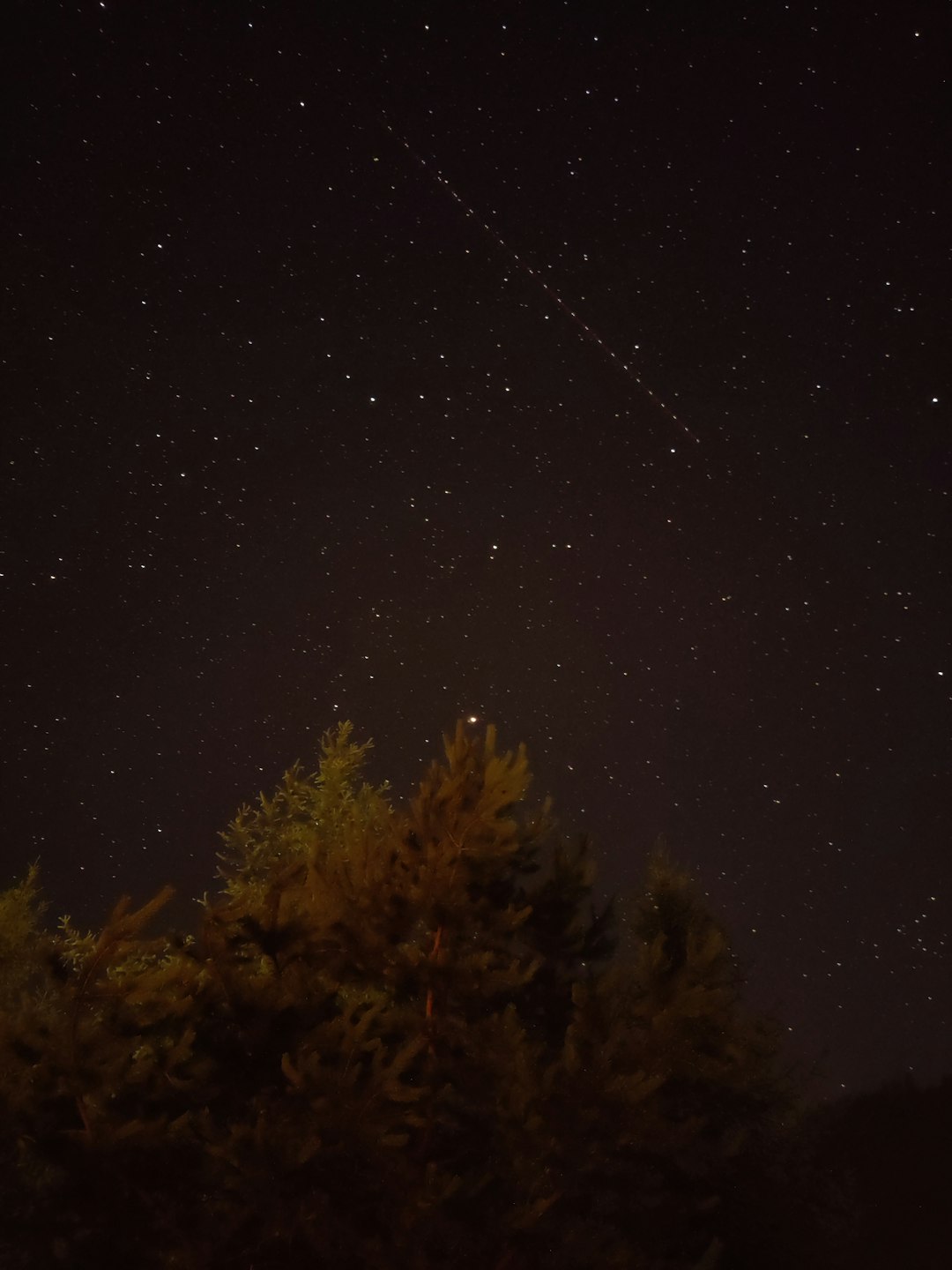
Spotted Something Strange in the Sky? Starlink Satellite or Meteor? Here’s How to Tell the Difference!
Let’s be honest. When you gaze up at the night sky and see something unusual, your first thought is probably, “What was that? A bird? A plane? Or, wait, a satellite?” And it’s no wonder, with thousands of them up there! SpaceX alone has launched over 9,000, and as of January 2026, we’ve already surpassed 15,000 satellites orbiting Earth. So yes, seeing them is incredibly common. But the confusion often begins when we mistake them for other celestial phenomena, like meteors.
The night sky offers a tremendous show, far beyond just stars. And while some things are instantly recognizable, you might be surprised to learn that even news reports sometimes mistakenly identify a satellite as a meteor. But they are not the same! Alyn Wallace, a renowned astrophotography expert, makes this distinction clear. The good news is that you, too, can learn to tell them apart, even if you’re a complete beginner.
The Key to Easy Identification
The simplest trick to determine if it’s a satellite or a meteor is to focus on its speed. Satellites move incredibly slowly compared to meteors. In fact, if you’re an astrophotographer, you’ll see it clearly: a meteor is a quick flash, appearing in just one shot. A satellite, on the other hand, will appear in several consecutive photos as it leisurely traverses the firmament.
And pay attention, SpaceX’s famous Starlink satellites are even easier to spot. Why? Because sometimes they appear as “lines” of bright, round lights, which we call “Starlink satellite trains.” You can see up to 60 of them in a row, looking like a snake of light crossing the sky!

Why Are They So Visible? And Why Do They Matter?
The reason we see so many satellites is that most are in Low Earth Orbit (LEO). That’s why they’re so “close at hand”! And beyond their visual spectacle, they are vital. They provide us with internet, assist with GPS; without them, we’d be more lost than ever. But besides speed, what else can you look for to identify that bright spot, especially if you’re new to this?
Pay Attention to the Trail and Color!
Here’s another golden tip: the trail they leave. It’s a crucial clue!
- A meteor is like a “POW!” of light. Its trail is asymmetrical, very bright, and only lasts for a fleeting moment, mere seconds. Sometimes you might even see it in colors like green or yellow—it’s spectacular!
- A satellite, on the other hand, is more “calm.” Its trail is more uniform, lasts much longer, and shines consistently from beginning to end. It’s typically white or slightly bluish.
How Does What You See Shine?
Here’s an interesting fact: satellites don’t have their own lights; they aren’t space lanterns! What you see is sunlight reflecting off them. That’s why the best time to catch them is just before dawn or after dusk. During these times, the sun is already illuminating them in space, but down here, the sky is dark enough for you to see them. It’s pure magic!
What if It’s an Airplane? Easy to Rule Out!
Other objects are a piece of cake to identify, especially in photos. If your captures show a string of bright points forming a straight, horizontal line, bingo! It was most likely an airplane. And if you see flashing red and green lights, or any exterior lights, don’t even think twice! It’s definitely an airplane. Neither meteors nor satellites have these “navigation” lights.
Ultimately, if you’re still in doubt or just want a little extra help, there are great apps for this. You have Star Chart, which is free, or SkySafari 7 Pro, which is more advanced (and costs around $21.99). But the most important thing of all: don’t overcomplicate it, and simply enjoy the incredible spectacle the sky offers us every night!